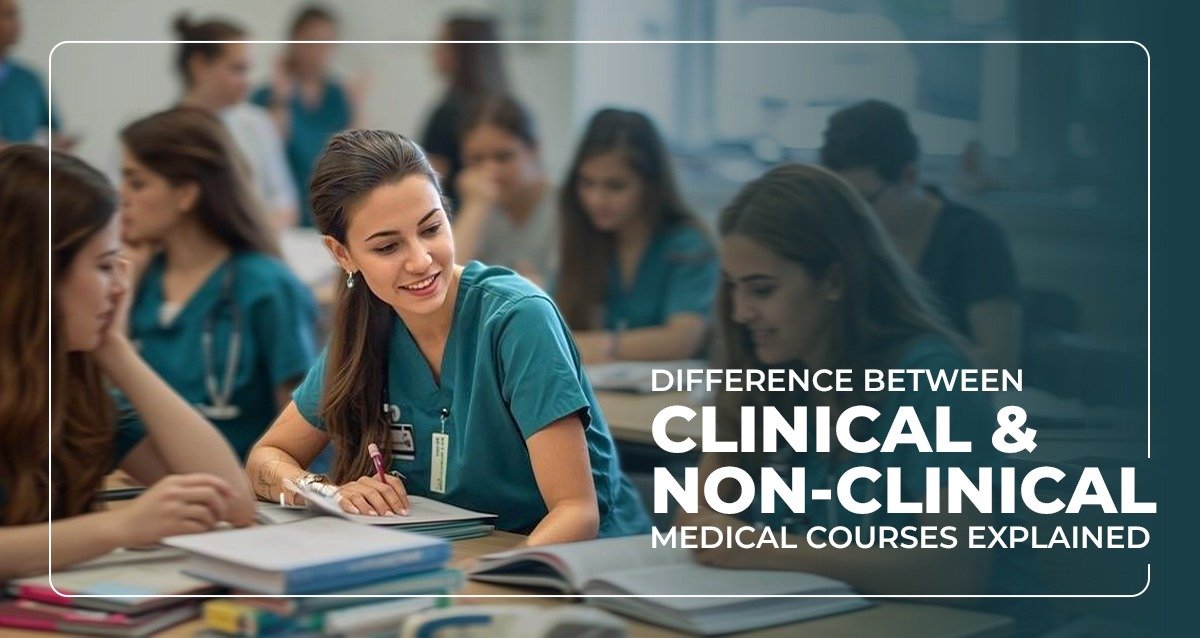
The decision to pursue a career in medicine is an exhilarating one; however, one should also know the distinction between the clinical and non-clinical medical courses. Clinical courses are concerned with direct patient care in which students are taught how to diagnose, treat, and communicate with patients at hospitals and clinics.
Non-clinical courses, however, involve more research, teaching, administration, and laboratory work, and do not involve interaction with patients. The two career paths are crucial in the medical system and provide a bright career choice. Understanding the differences between these courses will allow students to make the correct choice regarding the direction to take, depending on their interests, skills, and long-term career objectives.
What Are Clinical Medical Courses?
These are the types of courses that are pertinent to direct patient care. Students get to know how to study patients, diagnose the disease, and treat them in hospitals, clinics, and healthcare centres. Such courses entail practical training, internship, and on-the-job medical practise. Clinical courses may be a great option for those who like to meet people, solve problems in the health sphere, and work in a high-speed environment.
Trending Clinical Medical Courses
Here are some of the trending clinical medical courses mentioned below. Have a look at them one by one.
MBBS
The most popular medical course is MBBS. It prepares the students to be doctors who diagnose and prescribe treatments, and attend to patients in hospitals and clinics.
BDS (Dental Surgery)
It focuses on oral health. Dentists identify and remove the issues associated with the teeth, gums, and the mouth, assisting patients to take good care of their teeth.
BAMS / BHMS /BAMS (Ayurveda)
BHMS (Homoeopathy) emphasizes alternative medicine. These courses are focused on natural and holistic treatment.
BPT equips learners with skills that assist patients to heal after an injury, surgery, or other physical ailments using exercises and other therapeutic interventions.
This course equips learners to be patient carers, aids the physicians, and helps them through recovery compassionately and proficiently.
MD / MS (Clinical Specialisations)
Postgraduate courses such as medicine, surgery, paediatrics, or orthopaedics, MD, and MS enable doctors to specialise in their respective fields and have expert knowledge in clinical practise.
What are Non-Clinical Medical Courses?
Non-clinical medical courses are concerned with the support, research, and management aspects of healthcare other than direct treatment of the patient. These are the types of courses that students who are interested in science, technology, data, or administration can opt for. Although they are not directly engaged in interacting with patients, non-clinical professionals are vital in the diagnosis, research, hospital activities, and planning of health care for the population.
Non-Clinical Medical Courses
Here are some of the non-clinical medical courses mentioned below. Have a look at them one by one.
The course prepares students to carry out tests in the laboratories to assist doctors in diagnosing illnesses. Lab technicians deal with blood samples, tissues, and other specimens.
Students are taught to use imaging machines such as X-rays, MRI, and CT scans that are important in making a proper diagnosis.
BSc Biotechnology
This is the course that is dedicated to research and innovation in healthcare, such as drug development, genetics, and medical advancements.
Microbiology is the science that deals with the study of microorganisms like bacteria and viruses, and it aids in the prevention and control of diseases. Students who take this course can run hospitals, staff, and the medical system efficiently.
Public Health (BPH / MPH)
Public health has concentrated on the enhancement of community health by carrying out awareness programmes, research, and policy planning.
Health Informatics Medical Coding
This deals with the administration of medical information, coding, and the use of technology to enhance healthcare systems.
Career Opportunities in Clinical Medical courses
Clinical medicine courses lead to the fields of work that are directly connected to the care of a patient and practical work in medicine. These are the professionals who are in close contact with the patients, diagnose health conditions, and aid in recovery. As the healthcare demands increase, clinical careers are likely to provide stability, respect, and long-term development.
Doctor (Physician / Surgeon)
Physicians identify the diseases, prescribe them, and operate. They are involved in hospitals, clinics, or even practising privately, and contribute towards saving lives.
Dentists
A dentist specializes in oral health, where they treat oral diseases and assist their patients in keeping their teeth and gums healthy.
Physiotherapist
Physiotherapists treat the injured or post-surgical patients using physical therapy and rehabilitation procedures.
Nurse
Nurses are the ones who offer round-the-clock care, assist physicians, and provide care and therapeutic support to the patients.
Medical Specialist
Medical experts specialise in one particular area, like cardiology, paediatrics, or orthopaedics, and provide highly qualified and specialised services.
Career Opportunities in Non-Clinical Medical Courses
Non-clinical medical courses provide fulfilling careers to individuals who desire to be employed in the field of healthcare without treating patients directly. The roles assist the doctors, enhance health care systems, and aid in research and administration; hence are equally significant in the medical profession.
Medical Lab Technologist
They do laboratory tests on the samples, such as blood and tissues, to assist doctors in diagnosing and treating diseases in the correct way.
Radiology Technician
Radiology is a medical procedure that radiology technicians use in the operation of imaging machines, including X-rays, CT scans, and MRIs.
Healthcare Administrator
The healthcare administrators are in charge of the hospital operations, coordination of the staffs and healthcare services to facilitate efficient running of the hospital.
Medical Researcher
Medical scientists conduct research and testing to find new ways of treatment, drugs, and health care solutions.
Clinical Data Analyst
They process medical data and patient records to enhance the medical outcomes, efficiency, and decision-making.
What is Better: Clinical or Non-Clinical Medical Courses?
None of the courses is better or worse- the correct choice should be based on your interests, abilities, and career aspirations. Clinical and non-clinical medical courses have good career opportunities, and they are appropriate for various kinds of students.
Reasons to Choose Clinical Medical Courses?
Clinical courses suit students who like to work with patients and participate in practical medical care. When you prefer to socialise with others, find out the problems in their health, and directly affect the life of patients, you may find this way very satisfying. The careers in clinical are also characterised by high respect, long-term stability, and specialisation. They, however, have more studying time, practical training, and a high level of dedication to patient care.
Non-clinical courses are best suited to learners who want to work in fields of research, technology, data, or management in healthcare. They are usually less physically and emotionally demanding than the clinical roles; thus, they provide better work-life balance. The non-clinical professionals are important in diagnosis support, administration in health care, and medical innovation. This is the ideal career for a person who desires to work in the medical sector without having direct contact with patients.
Clinical and Non-Clinical Courses Eligibility
One should be aware of the eligibility criteria when selecting a medical course. Although both clinical and non-clinical paths typically have a science background, their application may vary in a difference in their entry requirements.
Clinical Medical Courses
- Should have Physics, Chemistry, and Biology (PCB) in 12 th standard.
- Most of the courses, such as MBBS and BDS, require the NEET qualification.
- The entrance exams could be supplemented by some allied clinical courses. The courses have practical training and an internship.
- High academic dedication and good health are necessary.
Non-Clinical Medical courses
- PCB is a must in the 12th standard
- Non-clinical programmes do not require NEET.
- Admission is usually made on a 12th-grade basis or university entrance examination.
- Fits well with any student wishing to pursue a career in medicine but not necessarily work with patients directly.
- Give more attention to laboratory, research, data, or management competencies.
Conclusion!
Clinical and non-clinical medical courses are significant to the healthcare system, and neither one is superior to the other. Clinical courses are best suited to those students who desire to deal directly with patients and participate in treatment and care. The non-clinical courses are an excellent option when one wants to do research, work in the lab, or manage healthcare.
The correct choice should be based on your preferences, strengths, and long-term objectives. Having the knowledge of the distinction between the two paths, students will be able to make certain choices and pursue the career in medicine that would be their passion and that would correspond to their future. If you want to pursue any of the courses, then enroll at KIIMS. We will help you to have quality education and better opportunities.