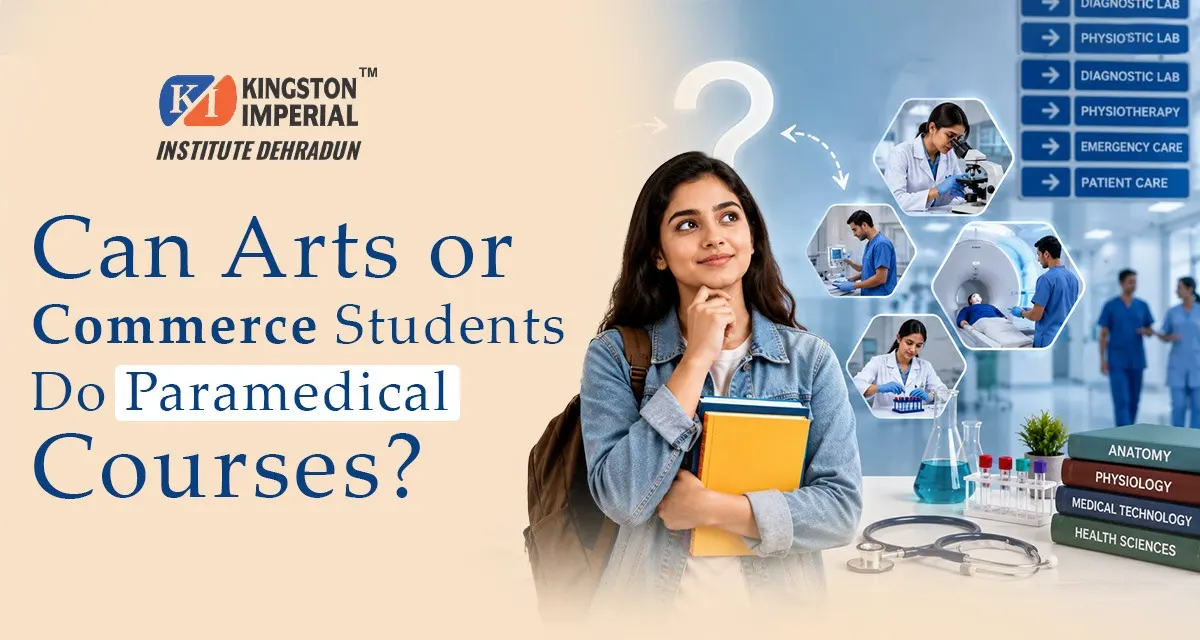
This question comes up more often than you’d think and the short answer is yes, in many cases they can.
There’s a widespread assumption that healthcare is exclusively a Science stream territory. And while that’s true for MBBS, BDS and a few other medical programs, it is not true across the board. The paramedical field is significantly broader than most students and parents realise and several programs in it are open to students from non-Science backgrounds.
If you finished 12th with Arts or Commerce and have been wondering whether a healthcare career is still possible for you, this blog is worth reading fully before you write off the option.
What Paramedical Actually Covers
Paramedical is an umbrella term for a wide range of healthcare support roles – professionals who work alongside doctors and nurses to diagnose, treat and manage patients. Physiotherapists, lab technicians, radiology technicians, operation theatre technicians and optometrists – all of these fall under the paramedical category.
The field is large, growing rapidly and genuinely in demand. India’s healthcare infrastructure is expanding with new hospitals, diagnostics chains, specialty clinics and rehabilitation centres are opening across the country. All of them need trained paramedical professionals and the shortage of qualified talent in many of these areas is real.
The Science Requirement - What It Actually Means
Most undergraduate paramedical programs do require a Science background at the 12th level – specifically Physics, Chemistry and Biology (PCB). This is because the curriculum covers human anatomy, physiology, biochemistry and clinical procedures that build directly on those subjects.
So courses like B.Sc Nursing, BPT (Bachelor of Physiotherapy), BMLT (Bachelor of Medical Laboratory Technology), B.Sc Optometry, B.Sc OTT (Operation Theatre Technology) and B.Sc Radiology typically require PCB in 12th as a standard eligibility condition.
This is the reality for most mainstream undergraduate paramedical degrees and it’s important to be honest about it rather than give students false expectations.
So Where Does That Leave Arts and Commerce Students?
Well, not without options but this is where things get a bit complex.
Paramedical courses for arts students and commerce students are available, though the range is more limited at the undergraduate level. Here’s where the realistic options lie:
Diploma and certificate programs in healthcare administration, medical billing, health information management and hospital front office operations often do not require a Science background. These are shorter programs that prepare students for operational and administrative roles within healthcare settings. These are the roles that are in consistent demand as hospitals professionalize their management functions.
Health management and hospital administration programs at the diploma or postgraduate level are accessible to students from any stream. An Arts or Commerce graduate who pursues a PG Diploma or MBA in Hospital Administration is very well-positioned for management roles in the healthcare sector without needing a clinical background.
Medical coding and billing is an emerging field that doesn’t require Science. It involves translating medical records and procedures into standardised codes used for insurance and billing purposes. Several certificate programs in this area are open to any graduate regardless of stream.
Community health and public health programs at certain institutions accept students from non-Science backgrounds, particularly at the diploma or PG level.
What About Commerce Students Specifically?
Paramedical courses for commerce students at the direct undergraduate level are limited for the same reason as Arts – the clinical science foundation that most degree programs require. However, the healthcare sector is a business as much as it is a clinical field and Commerce graduates have a genuine place in it.
Healthcare finance, hospital billing, medical insurance claims, pharmaceutical sales and healthcare supply chain management are all areas where Commerce graduates are actively recruited. The combination of commerce knowledge and an understanding of how healthcare systems work is a practical and valuable one.
A Commerce graduate who does a postgraduate program in healthcare management or health economics enters the sector with a differentiated skill set – analytical, financially literate and operationally aware in ways that pure science graduates sometimes aren’t.
The Honest Advice for Non-Science Students Who Want Clinical Paramedical Roles
If an Arts or Commerce student is genuinely drawn to clinical paramedical work like the laboratory, the operation theatre, physiotherapy, and radiology then the most direct path is to address the eligibility gap first.
Some students choose to appear for the NIOS (National Institute of Open Schooling) exams or equivalent open schooling boards to add Biology, Physics and Chemistry to their qualifications. This takes time and commitment but it makes them eligible for the full range of paramedical courses after 12th that require PCB.
It’s not the easiest route but for students who are genuinely committed to a clinical healthcare career, it’s a real and workable path.
Why Paramedical Is Worth Serious Consideration
Regardless of stream, the broader point is worth making: paramedical is a field with genuine long-term prospects. India’s healthcare sector is projected to grow significantly over the next decade. Diagnostic labs, multispecialty hospitals, physiotherapy clinics and eye care chains are all expanding. The demand for trained professionals across clinical and non-clinical healthcare roles is only increasing.
For Science students, the clinical programs are direct and well-defined. For Arts and Commerce students, the entry points are different but they exist and the careers they lead to are equally real.
Conclusion!
So can Arts or Commerce students do paramedical courses? For most undergraduate clinical programs, a Science background is required and that’s a fact worth knowing clearly. But the paramedical and healthcare sector is wide enough that non-Science students are not shut out of it. Diploma programs, health management courses, administrative and operational healthcare roles and postgraduate pathways all offer viable entry points. And for those committed enough to bridge the eligibility gap through open schooling, the full range of clinical programs becomes accessible too.
KIIMS – Kingston Imperial Institute of Medical Sciences in Dehradun has been preparing healthcare professionals since 2002 and it remains one of the most respected paramedical institutions in Uttarakhand. Affiliated with HNB Uttarakhand Medical Education University, the Indian Nursing Council and the Uttarakhand Para Medical Council, KIIMS offers a comprehensive range of programs such as BPT, B.Sc Optometry, B.Sc Medical Microbiology, BMLT, B.Sc OTT, B.Sc Radiology, GNM, B.Sc Nursing and several postgraduate programs – all delivered with the clinical training, experienced faculty and practical infrastructure that healthcare education demands.
For students who meet the Science eligibility criteria and are looking for the right institution to begin their paramedical journey, KIIMS provides exactly the kind of environment where that journey starts well. And for those still figuring out their path, the admissions team at KIIMS is available to guide students honestly toward the right program for their background and goals.
The healthcare sector needs good people. KIIMS is where many of them get their start.