When people think about careers in healthcare, doctors and nurses tend to dominate the conversation. But there’s an entire team of professionals working behind the scenes in operation theatres, sterile preparation rooms and surgical support roles without whom surgeries simply could not happen.
OT Technicians are among the most important of these professionals and their career prospects particularly in government hospitals are significantly stronger than most students realise.
If you’re considering a career in this field or are trying to understand whether it’s worth pursuing, this blog gives you an honest and clear picture of what the role involves, what the OT Technician career scope looks like in India’s government healthcare system and what you can realistically expect in terms of opportunity and growth.
What an OT Technician Actually Does
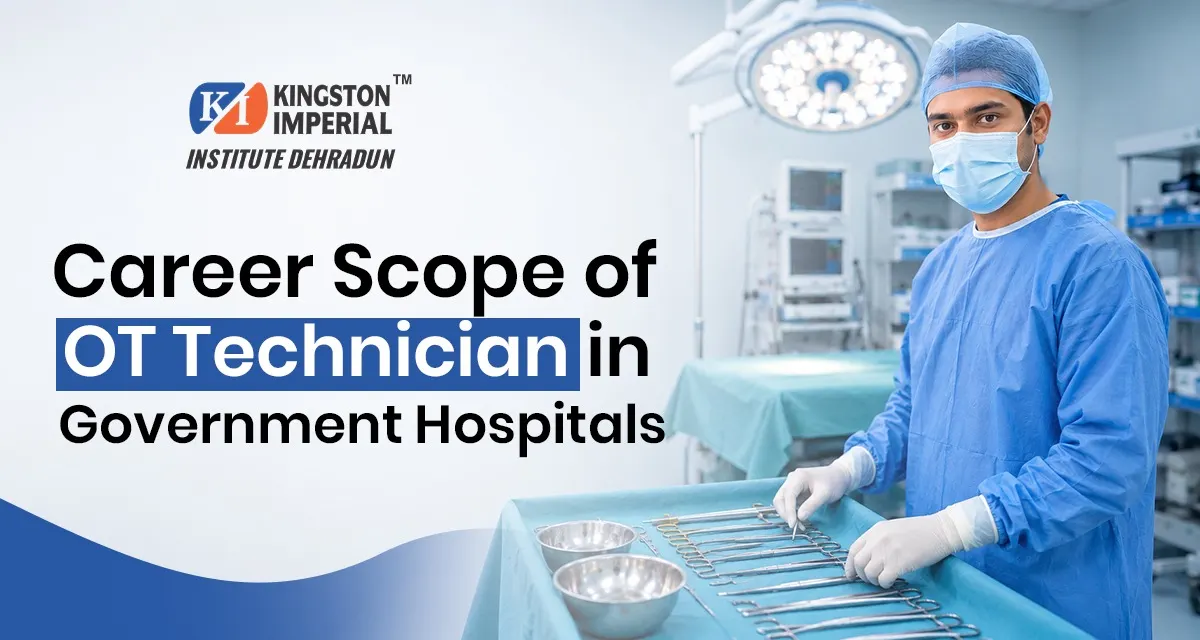
The Operation Theatre Technician’s responsibility is to prepare the operation theatre for surgery. Before any surgical process takes place, he/she will make sure that the theatre is clean and all the necessary equipment for the surgery is arranged and in perfect condition. This includes setting up the anaesthesia machine and the surgical lights.
When conducting the surgical process, he/she will work hand-in-hand with the surgical team. This is a task that requires an individual with great precision, knowledge about surgical processes as well as someone who works efficiently.
After the surgery has been done, he/she is required to sterilize and pack the instruments used during the surgery. In addition to that, he/she will clean the theatres to make sure that they are prepared for the next case.
Why Government Hospitals Are a Strong Career Destination
The government healthcare sector in India is one of the largest employers of paramedical professionals in the country. AIIMS hospitals, central government hospitals, state government medical colleges and attached hospitals, ESI hospitals, railway hospitals, defence hospitals – all of these institutions run large surgical departments with significant and ongoing demand for trained OT Technicians in government hospitals.
What makes government employment particularly attractive in this field is the combination of benefits it offers. Job security is one of them as government positions in healthcare are among the most stable available to any professional. The pay scales under the 7th Pay Commission are reasonable and come with regular increments. There are defined gratuity, pension and medical benefits. And the work environment, while demanding, is structured in a way that gives professionals a clear daily routine and career progression path.
For professionals who want a long-term, stable career in healthcare without the uncertainty that private sector employment can sometimes bring, OT Technicians in government hospitals have a genuinely strong proposition.
How to Get Into Government Hospital Roles
Government hospital positions for OT Technicians are filled through recruitment exams and direct selection processes conducted by bodies like:
- Staff Selection Commission (SSC) for central government health roles
- State Public Service Commissions for state government hospital positions
- AIIMS recruitment cells for positions at AIIMS institutes across India
- Railway Recruitment Board (RRB) for OT Technician positions in railway hospitals
- ESIC (Employees’ State Insurance Corporation) for ESI hospital positions
- Armed Forces Medical Services for defence hospital roles
Most of these require a B.Sc in Operation Theatre Technology or an equivalent diploma as the minimum educational qualification along with a valid registration with the relevant state paramedical council. Written examinations test general knowledge, basic science and subject-specific knowledge related to OT procedures and sterile techniques.
Candidates who come with proper clinical training alongside their degree tend to perform better in both the examinations and the practical assessment stages.
Operation Theatre Technician Career Opportunities Beyond Government Roles
While government hospitals are certainly great, it’s worth mentioning that Operation Theatre Technician career opportunities in the private sector are equally real and growing fast.
Corporate hospital chains, multispecialty hospitals, day surgery centres and specialty surgical clinics all need qualified OT Technicians. In metro cities and tier-1 towns, private sector salaries have risen considerably as the demand for trained professionals has outpaced supply.
Some experienced OT Technicians also move into:
- OT In-charge / OT Supervisor roles – managing the entire OT department and its staff
- Sterile Supply Department (CSSD) management – overseeing sterilisation processes
- Medical equipment training and sales – working with companies that supply surgical instruments and OT equipment to hospitals
- Teaching roles in paramedical colleges as clinical instructors once they gain sufficient experience
The field, in other words, does not lead to a dead end. It opens steadily over the course of a career for those who stay consistent and build genuine expertise.
Salary Expectations in Government and Private Sectors
For government positions, entry-level OT Technician salaries typically fall in the range of ₹25,000 to ₹40,000 per month depending on the institution and the state with additional allowances for HRA, transport and medical benefits. Senior and experienced government OT Technicians can earn considerably more especially in central government institutions.
In the private sector, fresh graduates typically start between ₹18,000 and ₹30,000 per month, with growth tied to experience, skill and the type of hospital. Senior OT Technicians with five or more years of experience in high-volume surgical settings command significantly better compensation.
What Makes a Good OT Technician Stand Out
The technical knowledge comes from the degree and clinical training. But what actually distinguishes a good OT Technician in a real hospital environment is attention to detail, discipline and the ability to remain calm and focused in high-pressure situations.
Surgical environments move fast and leave no room for error. Professionals who develop strong habits early build a reputation quickly, and that reputation opens doors.
Clinical training during the degree period is where these habits are built. Classroom knowledge matters but the OT environment can only be understood through actual time in it.
Conclusion!
The career scope for OT Technicians in India’s government healthcare system is genuine and growing. Stable employment, structured pay scales, defined benefits and a clear path for advancement make government hospital roles particularly attractive for professionals who want a long-term healthcare career without the volatility of other sectors. And for those who go private, the opportunities there are equally real and increasingly well-compensated.
KIIMS in Dehradun offers the B.Sc in Operation Theatre Technology as part of its comprehensive paramedical program portfolio. As one of the best paramedical colleges, KIIMS prepares OT Technology students with the right balance of academic knowledge and hands-on clinical training.
The faculty at KIIMS brings real healthcare experience into the classroom and the clinical training component is structured to give students actual exposure to OT environments and not just theoretical familiarity. This preparation directly supports students in clearing government recruitment examinations and in meeting the practical expectations of hospital recruiters in both public and private sectors.
So if you’re serious about building a career as an OT Technician and want to start with training that actually prepares you for the job then KIIMS is where that preparation happens properly.