What Are the Different Types of Nursing Jobs in Hospitals?
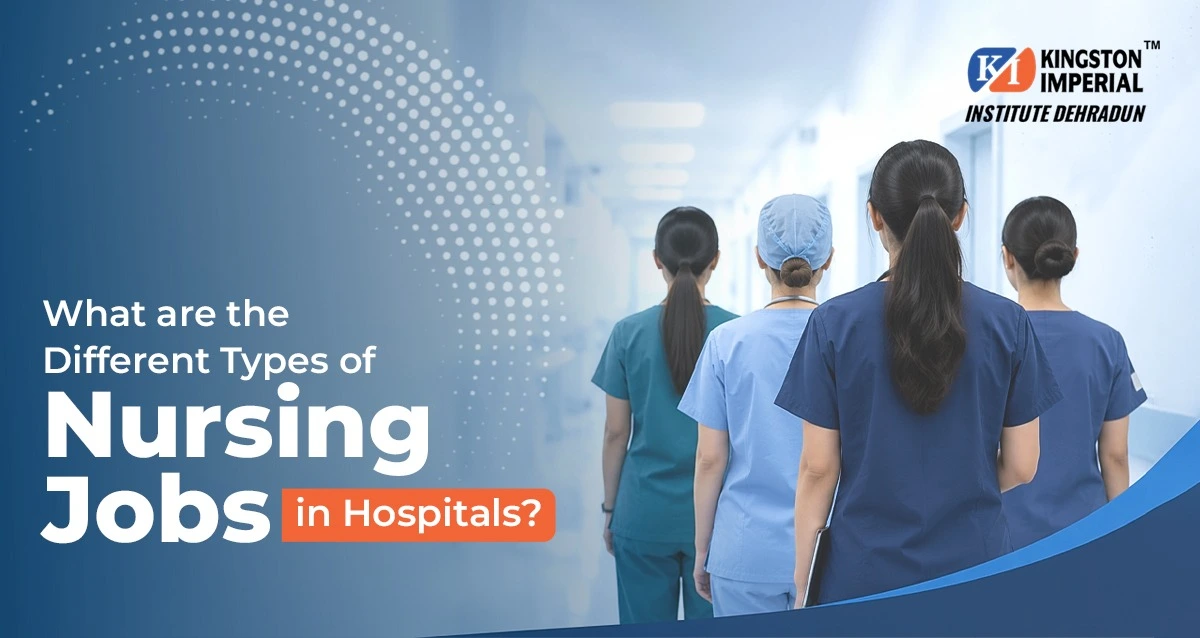
Nursing is important in hospitals since the field is quite dynamic and has various departments where effective nurses are needed to ensure that things are functioning well. Hence, nursing is one of the best careers in the health sector that one could consider if one would like to join this particular sector. One of the things that people aspiring to become nurses forget is that not all nursing careers are alike.
It is therefore very important to understand the types of nursing jobs in hospitals with different nursing careers to make an informed choice of the nursing career you want to take before enrolling in nursing school. There is something for everyone, whether you are inclined towards fast-paced emergency nursing, bedside nursing, or specialized nursing.
Let us have a look at some of the most common types of nursing jobs in hospitals.
1. Staff Nurse (Registered Nurse)
The Registered Nurse (RN), who is also called the Staff Nurse, is the very core of any hospital. Such professionals offer direct care to patients, dispense medicines, take vital readings, help doctors during clinical operations, and educate both patients and their families on the course of treatment.
Staff nurses work in almost all parts of a hospital, including general wards, ICUs, surgical wards, and many others. To be a registered staff nurse, an individual needs to have a Bachelor’s degree in Nursing or General Nursing & Midwifery.
2. Critical Care Nurse (ICU Nurse)
Critical care nurses perform their duties within Intensive Care Units (ICUs), where patients’ condition is critical, and they have to be monitored 24/7. Critical care nurses should have knowledge of using ventilators, understanding complicated heart monitors, giving emergency drugs, and reacting quickly to a decline in patients’ condition.
Doing this work means being an extremely decisive individual who isn’t emotionally unstable, and knows how to deal with being under tremendous pressure. This can be the most draining profession to work in in medical fields. Despite that, it can also be the best.
3. Emergency Department (ER) Nurse
Emergency nurses work within the casualty or emergency department, working with patients who have been admitted because of their injury, disease, or any kind of trauma. It is necessary for emergency nurses to have the ability to move quickly and adapt easily.
The ER nursing practice is extremely unpredictable and dynamic. There is no shift like the other, and everything can happen in the ER department. Emergency nursing might be the right choice if you enjoy working under adrenaline pressure and with diversity.
So in reality, the B.Sc Nursing vs Post Basic B.Sc Nursing is less about one being better than the other and more about where you’re starting from. A student straight out of school has no choice but the 4-year route. A working GNM nurse who wants a degree upgrade without repeating years of basic training goes the Post Basic way.
4. Surgical Nurse (OT Nurse / Operating Theatre Nurse)
These nurses are called Perioperative Nurses, but the more commonly known term is OT (Operating Theatre) Nurse. They work closely with surgeons and anesthesiologists as they scrub in to assist directly in an operation and the post-operative recovery process.
Their roles come in 3 phases: pre-, intra-, and post-surgical phases (preoperative, which includes pre-surgical preparation; intraoperative, assisting in the operation; and finally post-operative recovery). It demands accuracy, patience, and concentration skills to provide optimum patient care.
5. Pediatric Nurse
Pediatric nurses deal with the nursing care of infants, children, and adolescents. Pediatric nurses have to be very gentle, communicative, and skilful at soothing not only their young patients but also their patients’ worried parents, whom they help in pediatric departments or NICUs.
The pediatric nurse needs extensive knowledge of child development and skills in communicating differently to patients of various ages. This is one of the most emotionally fulfilling types of nurses in hospitals.
6. Maternity and Obstetric Nurse
Maternity nurses are called “labor and delivery nurses” and see women throughout their pregnancy as well as following delivery and birth. They are there throughout the entire process of giving birth. Maternity nurses will monitor the baby’s heartbeat, assist the mother in breastfeeding, and attend to the newborn.
7. Cardiac Nurse
Nurses in Cardiology attend to patients with heart disease, where they work in CCU, cardiac catheterization labs, and cardiology wards. Cardiac nurses assess heart rhythms, provide care to patients who have just had a heart attack or undergone heart surgery, and educate patients on healthy heart living.
In light of cardiovascular disease being very common, nurses in Cardiology are in high demand.
8. Oncology Nurse
An oncology nurse is responsible for providing care to cancer patients. An oncology nurse can give chemotherapy, treat the side effects of treatment, assess patients’ physical and psychological well-being, and educate patients and families about dealing with the effects of cancer.
Being a professional oncology nurse takes great empathy and psychological resistance because the relationships between nurses and patients can be built during the whole period of their treatment.
9. Nurse Educator
Nurse educators provide training and mentoring of nursing personnel and conduct continuing education in hospitals. The position is very suitable for experienced nurses who have a passion for education and professional growth.
Though nurse educators may not be involved in patient care on the bed as much as the bedside nurses, their job is critical in ensuring high-quality and safe health care services throughout the hospital.
10. Nurse Manager / Nurse Administrator
The position of nurse manager can be seen as an entry point for aspiring nurses in the administration of hospitals. The job involves supervision of nursing staff, staffing, scheduling, regulatory compliance, budgeting, and the initiation of quality improvement initiatives.
This position requires the integration of both clinical and managerial expertise.
Choosing the Right Path for Your Nursing Career
With the number of ways out there, the choices may seem quite daunting, which is precisely why it’s vital to develop the right foundation at nursing school. The field that you specialize in, the type of training that you receive, and the exposure you get from your studies determine what kind of nurse you will be.
This is why picking the right institution is something that really makes sense to invest some thought into. What distinguishes a good nursing program from others is the practical experience that comes with it, the mentorship from instructors, and your readiness to practice in any hospital department.
Why KIIMS Is the Rightful Choice
In relation to laying down a strong foundation, Kingston Imperial Institute of Medical Sciences (KIIMS) has all the right reasons to be the best nursing college in Dehradun. KIIMS believes that professional skills depend greatly on training quality. Thus, the institution provides high-level academic instruction and hands-on practical experience in the clinical environment.
The main feature that makes KIIMS special is the fact that nursing education in this institute includes not only theoretical classes but also practical experience acquired by nursing students in a real working hospital. In other words, graduates of this institute start their careers aware of the work of a hospital, knowing about the ICU pressure, surgical theatre precision, and patient empathy. They already know what the job is going to be like even before being employed.
For prospective students, this becomes a great advantage. This means that besides theoretical knowledge, you have practical experience that can give you the confidence needed to become successful in your chosen specialty. If your goal is to become proficient in various nursing professions or in clinical administration, then the training program at KIIMS will make you ready for success.
Final Thoughts
In conclusion, the main thing is to know what exactly you need from your education and career path. Spend some time looking for the right institution of higher learning that will develop your talents. The right choice of college can ensure you a bright future in both technological and healthcare areas.