What Subjects Are Taught in a Bachelor of Physiotherapy Course?
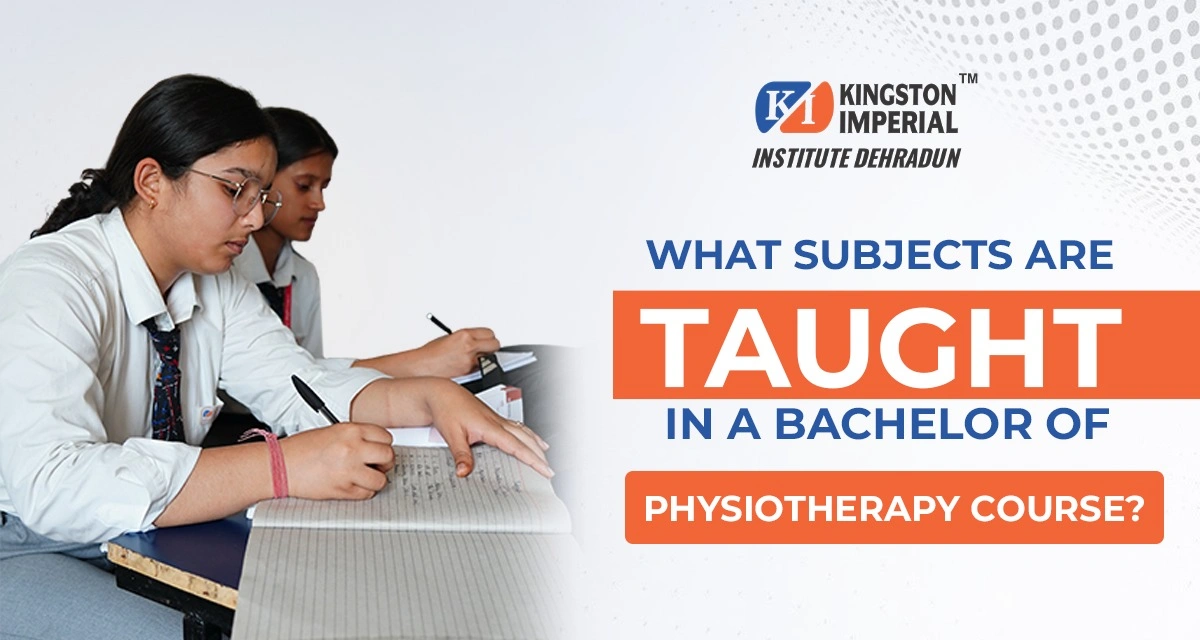
Bachelor of Physiotherapy (BPT) is a 4.5-year degree program (compulsory 6 months internship included) in India that helps students learn all the skills and knowledge required for evaluating and treating people with movement and physical dysfunctions using physical and manual methods.
If you are planning to pursue a career in physiotherapy, then understanding the BPT subjects will be your first step towards making a smart decision. Following is the information regarding the BPT subjects, which are taught for 4 years.
Year One: The Foundation (Pre-Clinical)
First Year Curriculum covers the basics of medical sciences and subjects associated with them:
- Human Anatomy – Study of the structure of the human body that includes bones, muscles, nerves, and organs, via a theoretical as well as dissection-based approach to studying anatomy.
- Human Physiology – Introduction to the functions of the human body. Topics include the heart and lungs, muscles, nerves, etc.
- Biochemistry – Chemical reactions in living things that involve metabolism, biological molecules, and enzymes.
- Psychology – Study of psychological aspects, human behavior, and the psychology of interaction between patients and practitioners.
- Sociology – Study of sociological aspects, family dynamics, and community health to help in holistic patient recovery.
Year Two: Para-Clinical Sciences
Second Year Links Basic Sciences to Clinical Knowledge:
- Pathology – Study of Diseases, Cell damage, and the effects of inflammation and injury on human body tissue.
- Pharmacology – Basics of medications, mechanisms of action, adverse reactions, and interactions of drugs with physiotherapeutic interventions in everyday life.
- Microbiology – Study of microorganisms, immune system functioning, and infections connected with hospital-acquired diseases.
- Exercise Therapy – A branch of physiotherapy that is concerned with therapeutic exercises, stretching, strengthening, goniometry, and ROM.
- Electrotherapy – The therapeutic use of electricity, heat, and mechanics, which includes ultrasound, TENS, IFT, and thermotherapy.
- Biomechanics and Kinesiology – (optional) Study of the mechanical laws relating to the movement of the human body during physical activity.
Year Three: Clinical Medicine and Specialized Physiotherapy
Year Three covers knowledge of clinical medical conditions and corresponding physiotherapy treatments:
- General Medicine and Pediatrics – Knowledge about systemic medical conditions, diseases of internal organs, and children’s diseases requiring rehabilitation.
- General Surgery and Obstetrics/Gynecology – Medical knowledge about pre- and post-operative conditions, burns, plastic surgery, and diseases of women.
- Orthopedics and Traumatology – Clinical knowledge about fractures, joint problems, bone diseases, spinal problems, and sports injuries.
- Physiotherapy in Orthopedic Conditions – Practical evaluation and rehabilitation of musculoskeletal and traumatic injuries.
- Neurology and Neurosurgery – Clinical knowledge about brain and spinal cord diseases and peripheral nerve diseases such as stroke and Parkinson’s disease.
- Physiotherapy in Neurological Conditions – Neurological rehabilitation methods and methods of motor retraining and function restoration.
- Research Methodology and Biostatistics – Basics of clinical research design, literature review, sampling, and statistical analysis.
Year Four: Advanced Specialization and Fundamental Courses
In the last academic year, advanced clinical specialization courses, advanced treatment methods, and public health issues are discussed:
- Physiotherapy for Cardiorespiratory Disorders – Chest physiotherapy, airway clearance, intensive care management, and pulmonary rehabilitation.
- Advanced Physiotherapy Techniques – Advanced techniques for manual therapy, joint mobilization (Maitland or Mulligan approach), and advanced treatment methods.
- Community-Based Physiotherapy & Geriatric Physiotherapy – Implementation of physiotherapy concepts in the field of community health, occupational health, ergonomics, and special geriatric requirements.
- Sports Physiotherapy – Injury prevention, emergency evaluation on the field, and sports-specific rehabilitation.
- Medical Ethics, Management, & Administration – Issues of professional medical ethics, documentation, health care management, and private practice clinic administration.
Career Opportunities After BPT
Once the studies are completed, one may begin working as a Physiotherapist. The Physiotherapist may begin practicing in hospitals, rehabilitation centers, sports centers, orthopedics centers, and geriatrics centers. Additionally, by furthering their education via a Master’s in Physiotherapy (MPT), the professional will be able to practice specifically in neuro, ortho, sports, or pediatric physiotherapy.
Conclusion: Choose KIIMS as Your Rightful Destination
Choosing the right institute is just as important as choosing the right course. The Kingston Imperial Institute of Medical Sciences (KIIMS), known as the best BPT college in Dehradun, becomes the obvious choice in that matter. Located within the scenic capital city of Uttarakhand, KIIMS provides an advanced academic program along with well-equipped laboratory facilities, skilled faculty members, and clinical experience at related hospitals.
For any nascent healthcare practitioner, selection of an institute that offers a complete infrastructure for development becomes inevitable. KIIMS provides not only an updated BPT syllabus but also the required clinical exposure along with guidance by expert medical professionals. Let us be your trusted and worthy choice for a career in physiotherapy.