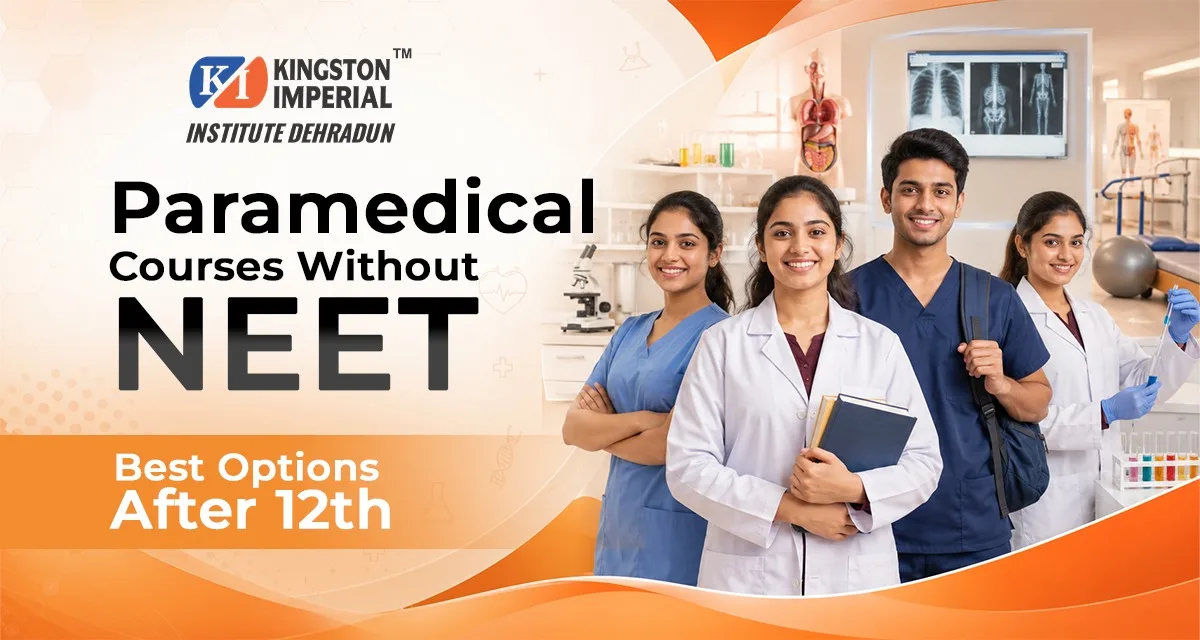
Not every student who wants a career in healthcare wants to go through NEET. And that’s completely fine because contrary to what a lot of students assume, NEET is not the only gateway into the medical field.
NEET is required specifically for MBBS, BDS and a handful of other clinical degree programs. But the paramedical sector which forms the backbone of every functioning hospital and diagnostic centre in the country runs almost entirely outside the NEET system.
Most paramedical courses without NEET are admitted purely on the basis of 12th-grade marks, sometimes combined with a basic institutional entrance test that has nothing to do with the pressure or scale of NEET preparation.
If you’ve finished or are about to finish 12th with Science and are looking for a genuine, respected, in-demand healthcare career without going through NEET, here’s a clear breakdown of your best options.
Why Paramedical Courses Don't Require NEET
NEET is specifically designed as the entrance exam for undergraduate medical and dental degrees — MBBS and BDS — because these are clinical degrees that lead to becoming a doctor or dentist with prescribing authority and the ability to perform surgery or complex clinical procedures.
Paramedical courses train students for a different, equally essential category of healthcare roles — physiotherapists, lab technicians, radiology technicians, optometrists, OT technicians and nurses, among others. These professionals work alongside doctors, often handling diagnostics, therapy, technical procedures and patient support. Because the regulatory and educational frameworks for these programs are different, the admission process doesn’t go through NEET. Instead, it’s based on 12th-grade performance particularly in Physics, Chemistry and Biology along with the specific eligibility criteria set by each program.
This is good news for thousands of students every year who are genuinely interested in healthcare but don’t want to go through years of NEET coaching and the intense competition that comes with it.
Best Paramedical Courses After 12th Without NEET
Here’s a look at the best paramedical courses after 12th that don’t require NEET, along with what each one actually involves.
B.Sc Nursing
A four-year program meant for educating students in clinical nursing roles. Nursing is one of the most popular career options in the field of healthcare not only in India but also abroad. Admission requirements are usually 12th PCB marks and sometimes an institution’s entrance exam.
BPT (Bachelor of Physiotherapy)
It is a newly emerged field of study with a great scope due to increasing awareness regarding physiotherapy, sports injury treatments and post-surgical recovery. People with this degree are employed in hospitals, sports institutes, physiotherapy centers and also open their private practice later on with experience.
BMLT (Bachelor of Medical Laboratory Technology)
A course designed to give a person the capability of working in diagnostic labs and performing tests which doctors use to diagnose diseases. As the diagnostic sector is booming in India, there is a huge demand for BMLT degree holders.
If you’re trying to decide between the diploma and degree route in this field, our blog on BMLT vs DMLT breaks down the differences in detail to help you choose the right path.
B.Sc Optometry
This program trains students in eye care — vision testing, diagnosing common eye conditions and managing optical devices and corrective lenses. Optometrists are needed in hospitals, eye care chains and private practices and the field has grown considerably with rising screen time and eye health awareness across the country.
For a closer look at what this career actually pays and how it grows over time, our detailed guide on B.Sc Optometry salary and career growth is worth reading.
B.Sc OTT (Operation Theatre Technology)
OT Technicians prepare and manage the surgical environment, assist surgical teams and handle sterilisation and equipment management. It’s a specialised, hands-on role that’s consistently in demand across both government and private hospitals.
B.Sc RIT (Radiology and Imaging Technology)
This program trains students to operate X-ray, CT, MRI and other imaging equipment — a technical and increasingly important role as diagnostic imaging becomes central to modern medical care.
GNM (General Nursing and Midwifery)
A three-year diploma program that offers a faster entry point into nursing for students who want to start working sooner with the option to pursue B.Sc Nursing later through bridge programs.
How to Choose the Right Paramedical Course
With so many genuinely good options, the right choice comes down to a few honest questions.
Do you enjoy working directly and closely with patients or do you prefer more technical, lab-based work?
Are you drawn to a specific area — eyes, surgery, physical rehabilitation, lab diagnostics?
And what is the realistic timeline you’re working with — some programs are three years, others four?
There’s no universally “best” answer here. What matters is matching your genuine interest and aptitude to the program because students who choose based on real interest tend to perform better and build more satisfying careers than those who choose based on assumptions about salary or perceived prestige alone.
What Comes After These Courses
One thing worth knowing upfront: choosing a paramedical course after 12th doesn’t close any doors. Most of these programs have clear pathways into postgraduate specialisation, research, teaching and even entrepreneurship. BMLT graduates, for instance, can specialise further into microbiology, haematology or biochemistry, while BPT graduates often go on to open their own physiotherapy practices once they’ve built sufficient clinical experience.
These career trajectories tend to grow steadily over time and the absence of NEET at the entry point doesn’t translate into a smaller or less respected career later on.
Conclusion!
NEET is not the only path into healthcare and for thousands of students every year, paramedical courses without NEET offer a genuine, respected and in-demand way to build a meaningful career in the medical field.
From nursing and physiotherapy to lab technology, optometry and radiology, the best paramedical courses after 12th cover a wide range of interests and career goals — all accessible through 12th-grade marks rather than a high-pressure national entrance exam.
Kingston Imperial Institute of Medical Sciences in Dehradun has been training paramedical professionals since 2002 and offers nearly all of the courses discussed in this blog — BPT, B.Sc Optometry, B.Sc Medical Microbiology, BMLT, B.Sc OTT, B.Sc RIT, GNM and B.Sc Nursing, along with several postgraduate programs for those who want to specialise further. Affiliated with HNB Uttarakhand Medical Education University, the Indian Nursing Council and the Uttarakhand Para Medical Council, KIIMS combines structured academic training with genuine clinical exposure — the kind of practical learning that prepares students for the real demands of a healthcare career, not just the examinations.
So if you’re a 12th-pass student who wants a real future in healthcare without going through NEET, KIIMS is a place where that path is laid out clearly with the right courses, the right training and the right support to help you choose well.