What Is the B.Sc Microbiology Course and Who Should Choose It?
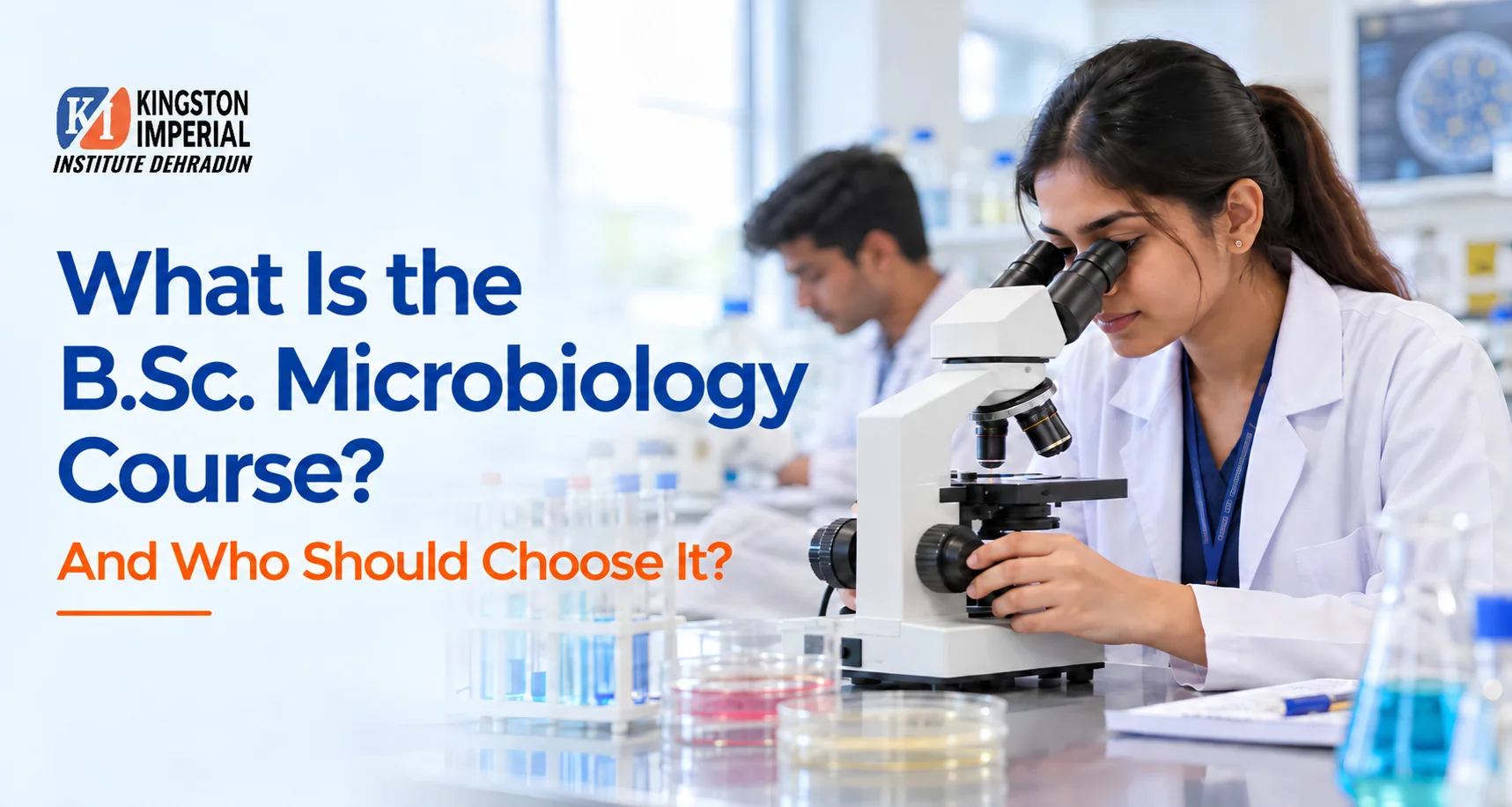
Microbiology is defined as the scientific study of organisms that cannot be seen with the naked eye, such as bacteria, viruses, fungi, algae, and protozoa. The discipline is very quiet but has a great influence in the modern day in the development of vaccines, antibiotics, food safety, agriculture, and industrial fermentation, among other important developments. In the case of a BSc Microbiology program, all of this science is converted into an undergraduate degree program over the course of three years.
This guide gives insight into what the course entails, the subjects studied in the course, and, most importantly, how to know whether the course is right for you.
What Is the B.Sc Microbiology Course?
The BSc Microbiology course is a three-year undergraduate programme (six semesters under the choice-based credit system) which confers a Bachelor of Science. This course falls under the life sciences group and includes both theoretical and practical training.
While degrees like B.Sc Life Sciences and B.Sc Botany are broad-spectrum and have diverse topics covered in them, the BSc Microbiology course has an exclusive focus on micro-organisms and their relationship with humans, animals, plants, and the environment. This is why professionals in this field are in demand in industries that require contamination control, microbiological testing, and sterility procedures.
Candidates who have studied 10+2 with Biology as one of their subjects are eligible for this course, and some universities may even admit candidates with Mathematics or Agriculture as their subject along with Biology.
Higher Study Options After B.Sc Medical Microbiology
Here’s where things actually branch out and it helps to look at these as separate tracks rather than one obvious next step.
- M.Sc in Microbiology, Biotechnology, Biochemistry or Public Health — this is the most common route and it’s the one most recruiters and research bodies expect to see if you’re aiming for a lab-leadership or research-track role.
- PhD after your Master’s — for students who genuinely enjoy research and want to go deep into a specific area, a doctorate opens up academic and senior research positions later on.
- Entrance-exam routes like CSIR-NET, ICMR and DBT-JRF — clearing these gets you into research fellowships and eventually academic positions without necessarily needing a separate professional degree first.
- M.Sc in Clinical Microbiology or allied health certifications — a better fit if you’re more clinically inclined and want to end up in hospital or diagnostic-lab settings doing hands-on, patient-facing work rather than pure research.
These courses after BSc Medical Microbiology aren’t exclusive either — a lot of students do an M.Sc first and then decide whether NET or a PhD makes sense based on how the Master’s years go.
BSc Microbiology Subjects: What You Will Actually Study
The syllabus is pretty much the same throughout all Indian universities, with minor variations in the names of the papers. Here’s how it usually goes:
- Year 1 – Fundamentals: Microbiology & Microbial Diversity, Cell Biology, Biochemistry, and Chemistry & Physics papers. Students are introduced to microscopy, staining techniques, and aseptic handling – the basic physical techniques of the subject.
- Year 2 – Fundamental Mechanisms: Microbial Physiology & Metabolism, Genetics & Molecular Biology, Immunology, and Medical Microbiology. This is when the degree gets challenging as you transition from organism identification to mechanisms of their physiology, mutation, and pathogenicity.
- Year 3 – Applied & Advanced Subjects: BSc Microbiology subjects include Industrial Microbiology, Environmental Microbiology, Food & Dairy Microbiology, Virology, and Recombinant DNA Technology. Electives are typically included in most programs, with specialization opportunities within areas such as biotechnology or clinical diagnosis.
Laboratory work proceeds alongside. Students spend a good amount of their time growing cultures, conducting assays, doing serology testing, and preparing lab reports. Assessments consist of theoretical examinations, practicals, internal evaluations, and, in most cases, a dissertation in the last year.
Who Should Choose This Course?
The truth of the matter is that this subject suits a unique kind of student. There is a shift from science to practice, which means that if you match any of the following characteristics, you will enjoy the program:
- Fascinated by Invisible Biological Processes: The area requires you to have a very high level of imagination and curiosity about invisible biological processes. If you like learning how it is possible for a single microscopic change to cause a pandemic or how engineered yeasts ferment industrial bio-compounds, then this course is for you.
- Precise: The laboratory class has a lot of precision and structure. If a single Petri dish is not up to standard or one of the cultures is incorrectly labeled, it makes all your work invalid in an instant. If you enjoy tasks that are precise and hands-on, then this course is for you.
- Being Comfortable at the Intersection of Sciences: The advanced study of microbiology lies squarely at the intersection of biology and chemistry. You need an equal comfort level with both of them since having a poor foundation in either of them would make your papers on microbial metabolism, biochemistry, and molecular genetics much more difficult to navigate.
- Preparing for Specialization or Research: The bachelor’s degree represents your point of departure from which you can continue developing in any way you choose. If your goals include a smooth transition into M.Sc. specialization tracks, biotechnology research, public health management, or a technical field such as quality control in the pharmaceutical industry, then this course will give you a solid ROI.
- Looking for a Sustainable and Standardized Set of Skills: Clinical diagnostic labs, production lines, and the food safety industry are obliged by law to hire certified microbiologists because the job cannot be easily replaced by automation due to the need for human decision-making.
Who Should Think Twice?
Honesty works wonders in this situation. If you are seeking a program that requires little laboratory time, or you have chosen microbiology simply because you could not gain admission to your preferred program, you might be disappointed. This program alone will not ensure that you will get well-paid entry-level employment; most people who graduate require a master’s degree or some other type of certification in order to earn a competitive salary.
Career Paths After the Course
Career opportunities include work in clinical and diagnostic labs, the pharmaceutical and vaccine industry, food and drink quality control, biotechnology firms, agricultural science, environmental science, and research at universities. There are government careers through public health labs and research institutions. Another common career is teaching, with appropriate qualifications.
Conclusion
Choosing which degree one should study in college is essentially choosing what one wants to do as an occupation later on, and the B.Sc. Microbiology degree can be recommended to students who are interested in healthcare, research, or industrial work, provided they do not mind working in the laboratory. The most important thing is to study in a college where the practical aspect of education is valued equally with theoretical studies, since here, the key point to employability is doing it in practice, not only learning it.
This is the reason why the B.Sc Microbiology Course in Uttarakhand at KIIMS is a reasonable choice. The focus of the institution on providing its students with proper laboratory experience and applying knowledge makes graduates of the institute possess the skills that any employer or admissions committee for postgraduate education expects from candidates. When it comes to a field in which competence is measured precisely by the use of a certain technique, a university based on this principle gives future microbiologists a valuable advantage.
Also read: Higher Study Options After B.Sc. Medical Microbiology